

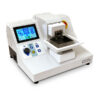

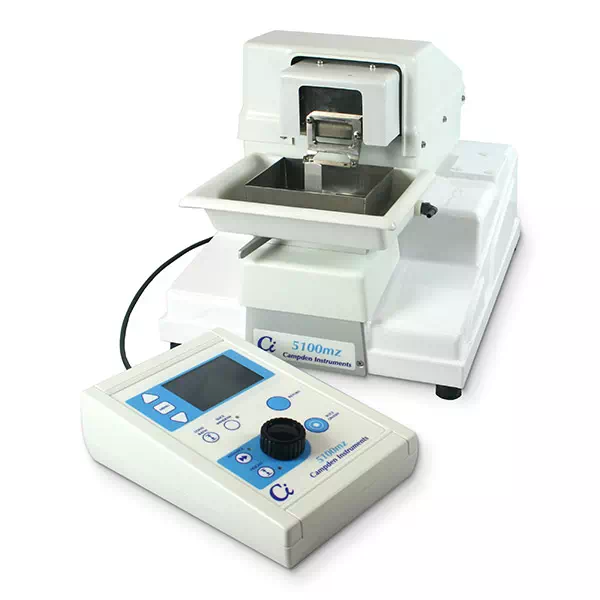
Campden 5100mz Vibratome
Not sure which configuration is right for your application? Schedule a free consultation with our technical consultants today!
Schedule a consultationProduct Description
- Includes the Z-axis calibration unit (5100mz-Plus only)
- Vibration frequency from 50 to 80 Hz
- Adjustable amplitude from 0.5mm to 1.5mm
- Fine control of the blade advance (min. 0.1 mm/sec)
- Set start and finish position of blade travel
- Remote controls allowing for sterile use in culture hood
- Ice water bath easily removed for cleaning
- Optional cold light and magnifier for clear observation
- Optional Peltier cooled bath
Use in fully manual or the semi-automated “Slice window” mode which automatically remembers the start and finish position of the slice. This New entry-level Microtome is perfect for techniques such as histology, organotypic slice culture and low resolution imaging with a fixed blade holder and a mechanism Z axis error of ≈ 5-8µm.
Specifications
- Section thickness step size: 0.001 mm
- Bath table rise & fall speed: 1.0 mm/sec maximum
- Maximum (vertical) travel of bath table: 19 mm
- Cutting head advance speed: Minimum: -2.0 mm/sec (-1.00 during slicing); Maximum: +2.0 mm/sec (+1.00 during slicing)
- Cutting head retraction speed: 2.0 mm/sec
- Maximum travel of cutting head: 40 mm
- Blade oscillation frequency: Minimum: 50 Hz; Maximum: 80 Hz (amplitude dependent)
- Frequency step size: 5 Hz
- Blade oscillation amplitude: Minimum: 0.5 mm (nominal); Maximum: 1.5 mm (nominal)
- Amplitude step size: 0.5 mm (nominal)
- Power requirements (Selectable): 115VAC 60Hz, 230VAC 50Hz
- Power rating: 100W
- Fuse rating: 115V: T2A 250VAC; 230V: T2A 250VAC
- Light source: Powered from 5100mz
- Dimensions: 350mm Width x 450mm Depth x 350mm Height (excluding magnifier/light source)
- Weight: 15kg (excluding magnifier)
Designed for Scientists, Backed by Innovation
Campden Instruments has collaborated with leading researchers across various research disciplines to build a vibratome that meets real-world laboratory challenges. Find confidence and precision with the 9000SMZ.
✔ Cleaner Slices
✔ Higher reproducibility
✔ Confidence from the very first cut
Dr. Gareth Morris of University of Manchester and University College London talks about his research and how the use of Brain Slices provides an invaluable, in vitro research tool.
Dr. Kate Connor from Trinity College Dublin talks about her research into the development of clinically relevant cancer models and the use of brain slices for model validation.
Only logged in customers who have purchased this product may leave a review.
- Section thickness step size: 0.001 mm
- Bath table rise & fall speed: 1.0 mm/sec maximum
- Maximum (vertical) travel of bath table: 19 mm
- Cutting head advance speed: Minimum: -2.0 mm/sec (-1.00 during slicing); Maximum: +2.0 mm/sec (+1.00 during slicing)
- Cutting head retraction speed: 2.0 mm/sec
- Maximum travel of cutting head: 40 mm
- Blade oscillation frequency: Minimum: 50 Hz; Maximum: 80 Hz (amplitude dependent)
- Frequency step size: 5 Hz
- Blade oscillation amplitude: Minimum: 0.5 mm (nominal); Maximum: 1.5 mm (nominal)
- Amplitude step size: 0.5 mm (nominal)
- Power requirements (Selectable): 115VAC 60Hz, 230VAC 50Hz
- Power rating: 100W
- Fuse rating: 115V: T2A 250VAC; 230V: T2A 250VAC
- Light source: Powered from 5100mz
- Dimensions: 350mm Width x 450mm Depth x 350mm Height (excluding magnifier/light source)
- Weight: 15kg (excluding magnifier)
Related products
Vibrating Microtomes
Vibrating Microtomes
Reviews
There are no reviews yet.